UNIST site map
- Admissions
-
Academics
- Colleges and Schools
-
Academic Affairs
- Academic Calendar
- Academic Curriculum
- Requirements for Graduation
- Browse Open Courses
- Undergraduate Administration
-
Graduate Academic Affairs
- Tuition Fee Payment
- Academic Leave of Absence/ Academic Return
- Voluntary Withdrawal/ Expulsion
- Change of Major
- Change of Degree Program/ Dropping of Degree Program
- Class Period/ Attendance Period/ Academic Year・Semester
- Course Registration
- Course Drop
- Attendance/ Grade/ Exam
- Credit Transfer/ Credit Carryover
- Academic Forms
- Education Support
-
Research/Industry
- Research Aims
- Research Findings
- Researcher Search
-
Research Organizations
- UNIST Multi-Interdisciplinary Institute
- IBS Research Groups
-
UNIST Labs
- Department of Mechanical Engineering
- School of Energy and Chemical Engineering
- Department of Civil
- Department of Materials Science and Engineering
- Department of Nuclear Engineering
- Department of Industrial Engineering
- Department of Design
- Department of Biomedical Engineering
- Department of Biological Sciences
- Department of Electrical Engineering
- Department of Computer Science and Engineering
- Department of Mathematical Sciences
- Department of Chemistry
- Department of Physics
- School of Business Administration
- Graduate School of Carbon Neutrality
- Graduate School of Artificial Intelligence
- Research Support
- University-Industry Relations
- Campus Life
- News Center
- About UNIST
-
etc
- UNIST Bulletin
- Work-Life Balance Support System
- UNIST Gender Equality Plan
- Faculty Invitation for Tenure Track
- Faculty Invitation for Non-Tenure Track
- Board Meeting Minutes
- University Council Meeting Minutes
- Administrative Service Charter
- Privacy Policy
- Copyright Policy
- Rejection of Unauthorized Email Collection
- Operation and Management Policy for Video Information Processing Devices
- Information Disclosure


Connection Points of Knowledge, Everything About UNIST
Try searching.
Recommended search terms


- portal
- U Academics Innovation Center
- Leadership Center
- Dormitory
- Academic Information Center
- International Students Support
- Browse Open Courses
- Course Registration
- Graduation Requirements for Graduation
- Academic Leave of Absence/ Academic Return
- Military Service
- Certificate Issuance
- Academic Calendar
- Scholarships
- Campus Map
- Campus Life Guidebook
- Health Care Center
- Human Rights Center
- portal
- Job Opening
- Announcement for Bid
- UNIST AI Services
- UNIST Daycare Center
- Sports Center
- UI Downloads
- Announcement
- Recruitment of Professors (Non-tenure)
- Faculty Invitation for Tenure Track
- UNIST Academic Information Center
- Office of Research Facilities and Training
- Office of Research Affairs
- Rule Management System
- Academic Calendar


This is a collection of menus necessary for UNIST students .
students
- portal
- U Academics Innovation Center
- Leadership Center
- Dormitory
- Academic Information Center
- International Students Support
- Browse Open Courses
- Course Registration
- Graduation Requirements for Graduation
- Academic Leave of Absence/ Academic Return
- Military Service
- Certificate Issuance
- Academic Calendar
- Scholarships
- Campus Map
- Campus Life Guidebook
- Health Care Center
- Human Rights Center


This is a collection of menus necessary for prospective UNIST Students .
prospective Students


This is a collection of menus necessary for UNIST Faculty & Staff .
Faculty & Staff
- portal
- Job Opening
- Announcement for Bid
- UNIST AI Services
- UNIST Daycare Center
- Sports Center
- UI Downloads
- Announcement
- Recruitment of Professors (Non-tenure)
- Faculty Invitation for Tenure Track
- UNIST Academic Information Center
- Office of Research Facilities and Training
- Office of Research Affairs
- Rule Management System
- Academic Calendar


NEWS CENTER
Discover not only Research Findings and event news, but also the diverse facets of UNIST presented by reporters and writers.
News Center

UNIST News
Ultra-Sensitive Wearable MXene Sensor for Real-Time Human-Machine Interfaces
Their findings have been published in Advanced Functional Materials on April 11, 2026.
- Research
- JooHyeon Heo
- 2026.05.18
- 195

Abstract
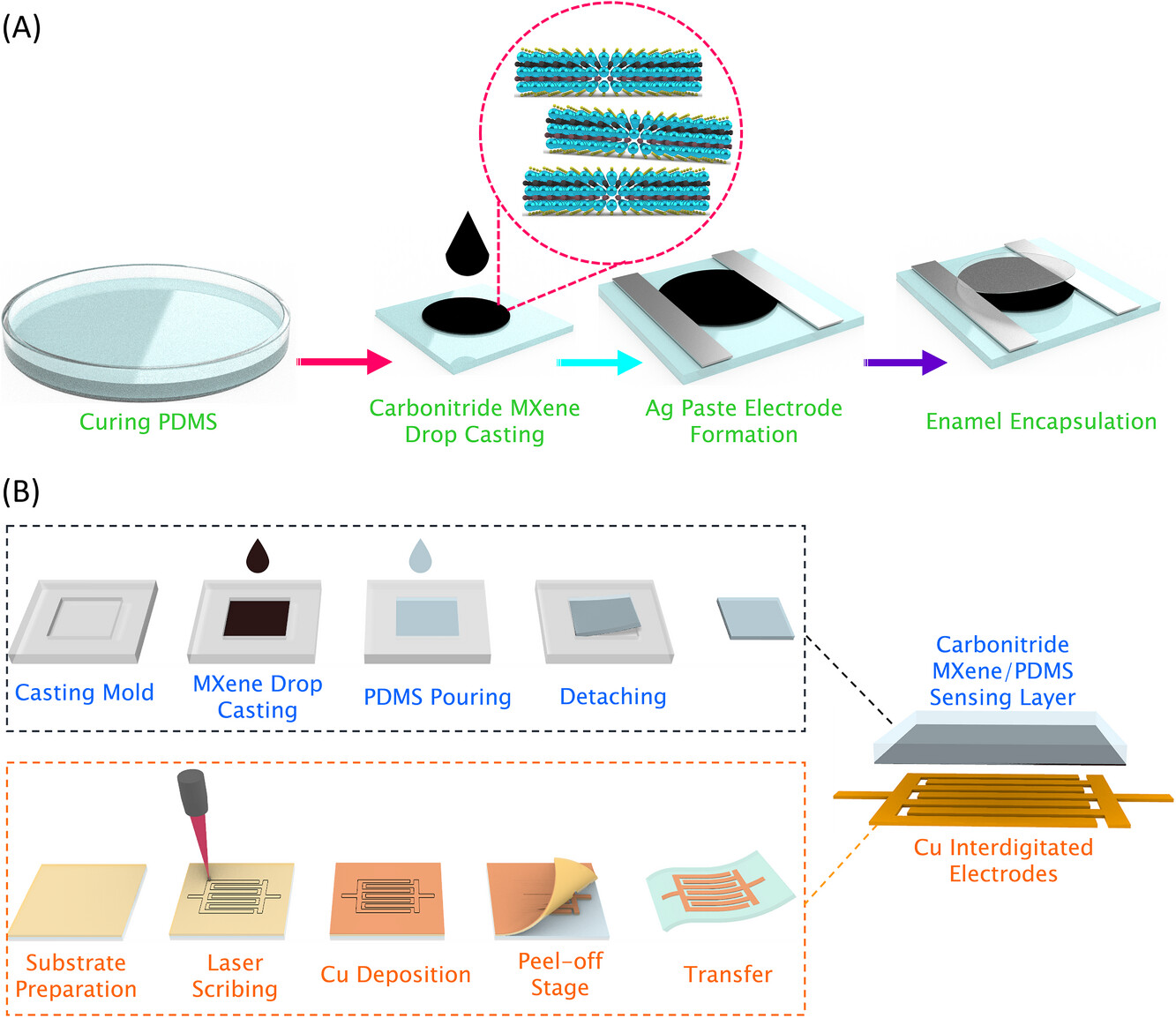
In practical applications, sensors made from this MXene accurately distinguish subtle vocal cord vibrations, blinking, pulse waves, and gait patterns—all without direct contact. Remarkably, they can even detect temperature changes from a short distance, such as infrared heat emitted by a smartphone flash.
Professor Kim highlights that this multifunctional sensor represents a transformative development in next-generation human-machine interfaces and electronic skin. Its versatility paves the way for numerous applications in healthcare, energy storage, catalysis, and electromagnetic shielding.
Professor Debananda Mohapatra, the first author of the study, emphasized that this 2D MXene advancement sets a new benchmark in intelligent sensing, enabling next-generation sensing devices to bridge human–machine interfaces with exceptional sensitivity and scalability. Also said, this work serves as a stepping stone for the vast 2D MXene family of nanomaterials, accelerating applications across healthcare, AI robotics, and smart wearables.
Journal Reference
Debananda Mohapatra, Ju-Hyoung Han, Hyun Jin Kang, et al ., “Anomalous Pressure-Temperature Ultrahigh Sensitivities in Atomically Engineered Carbonitride MXenes for Multifunctional Wearable Human–Machine Interfaces: Joint Computational–Experimental Elucidations,” Adv. Funct. Mater., (2026).
Related Links


-
New Study Unveils High-Performance Dye-Sensitized Electrode for Artificial Photosynthesis
-
New Electrode Converts CO2 into Chemicals While Generating Electricity
-
Ultrafast 3D Microfabrication Technology Produces Complex Structures in Just 60 Seconds
-
New AI Algorithm to Enhance Accuracy of Thermal and Stress Predictions in Semiconductors